


The Leviathan
- fiona flint books

- Feb 10
- 3 min read
The Great Eastern, launched in 1858, was more than just a ship. She was the largest ship ever built, by some margin, a feat of what has been described as 'Victorian ingenuity'. The writer Jules Verne described her as 'a floating city'.
She followed several previous large iron-clad steamships designed for the passenger route to America, and was intended for the run to Australia. The idea behind these large ships was that they could carry enough fuel to go long distances without putting in to port. She was not a success as a passenger ship, however. After a number of disastrous runs between England and America, she was abandoned.
Then came her moment to shine. Engineers were looking for a solution after a failed attempt at laying cable in the Atlantic. The Great Eastern's size meant she could store the 4500 tons of metallic wire needed and remain stable while carrying out the cable-laying operation. Huge tanks were installed so that the cable could be carried already immersed in water to its destination and the operation was a success.
Jules Verne's novel 'A Floating City' describes in detail her conversion back into a passenger ship. He describes 'fly-wheel cranes ... raising enormous pieces of cast-iron', scaffolding and steam-windlasses hoisting heavy joists. He says that 'building, fixing, carpentering, rigging, and painting' went on 'in the midst of ... greatest disorder'.
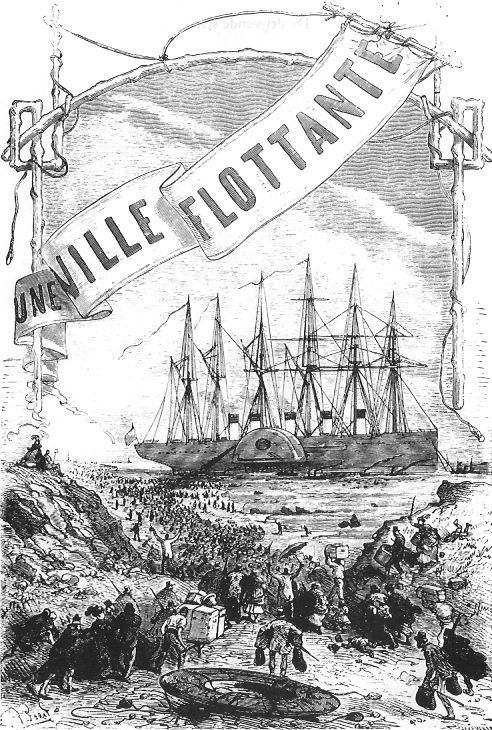
His account, based on a trip to New York he actually made himself in 1867, goes on to describe what it was like aboard the Great Eastern on a voyage to America. He tells us about the ships's technical innovations, for example, the wonder of the steam-powered steering ...
"The steersman ... has only to press his hand lightly on a small wheel, measuring hardly a foot in diameter, and immediately the valves open, the steam from the boilers rushes along the conducting tubes into the two cylinders of the small engine, the pistons move rapidly, and the rudder instantly obeys. A man will be able to direct the gigantic body of the Great Eastern, with one finger"
But his novel also highlights superstition surrounding the giant vessel...
"strange stories are told about this ship ... they say that a passenger who lost his way in the hold of the ship, like a pioneer in the forests of America, has never yet been found”
One of the characters is convinced the ship is 'bewitched' because of the fate of several prominent men associated with her - a captain who drowned, an engineer 'melted by mistake in the steam-box' and even Isambard Kingdom Brunel himself, who built her and died soon after.
Whether in terms of her size, her technical innovations, the strange stories about her or her six masts and five funnels, the Great Eastern left an impression. Jules Verne describes his first sight of her, before embarking, at Liverpool ...
"I caught a glimpse of her imposing bulk from the first bend in the river. One would have taken her for a small island, hardly discernible in the mist."
The local newspapers were full of anticipation ahead of her arrival at Sheerness in June 1870. There was an atmospheric mist that night, too, according to the Sheerness Guardian and East Kent Advertiser...
"The evening was very hazy, so that vessels below the Nore could not be distinguished"
And there was something otherworldly about the Great Eastern herself ...
"The great ship presents a strange appearance, being painted all over with a light colour, which experiment has been found very successful in protecting the sides of the vessel against the heat of the sun in tropical climates"
Again, this juxtaposition of technical advance and atmospheric meaning so characteristic of the Victorians.
The Great Eastern had just returned from Bombay and she had, once again, successfully laid cable. A party of riggers were sent out from the Dockyard to her mooring a mile from Sheerness Pier to help secure her in the Medway. Given that 'three-mast ships looked like barges' alongside her, according to Verne, one wonders what the riggers' lighters (a form of barge) looked and felt like.


Comments