


Sanger's Horses
- fiona flint books

- Jul 1
- 3 min read
Horses were the at very heart of Sanger’s Circus, which featured equestrian acts such horse ballerinas and acrobats. In 1861, the circus boasted 'the finest stud of 80 trained horses and ponies' for its visit to Sheerness.

Often a representative would visit a town to buy up more horses ahead of the circus arriving, so local dealers must have been used to bargaining with them.
In his book 'Seventy Years a Showman', Sanger refers to purchasing a Welsh pony at Croydon October Fair and training horses 'to gallop circus fashion' in the yard of a public house.
One of his attractions was a fortune-telling pony which would be sent round the ring to discover 'the biggest rogue' - it had, in fact, been trained to point out the ring master. Sanger also trained a spotted horse bought from an Irishman near Liverpool to perform as Mazeppa, the Wild Horse of Tartary.
Sanger's circus horses travelled by steam ship to the Continent with the circus in the 1870s. In 1881, several horses brought over from Boulogne were taken to land near Sandwich to graze while circus carriages were being renovated at Hall-by-the-Sea.
Some horses might be put to work on farms over winter, so that somebody else paid for their upkeep. One of George Sanger’s horses went to Cliffs End Farm, Ramsgate at Michaelmas 1889, alongside others belonging to Hancock and Jordan's bathing machine establishment at Margate.
George Sanger's horse was returned early, being unfit to work, and another was so over-worked and underfed that a vet recommended immediate euthanasia. This was carried out at Sanger's slaughteryard at Hall-by-the-Sea and Mr Hancock received 25s for it. This slaughteryard, which was screened from the paying public by a folly, provided the quantities of fresh meat required to feed the animals housed in Sanger's Menagerie.
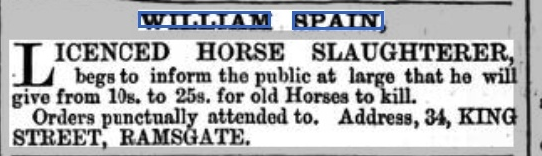
My great grandfather's brother Jim was only offered 15s for an old and useless horse at Hall-by-the-Sea. He despatched it himself the next day, presumably because he could make more profit from the sale of its component parts. Perhaps the price offered depended on the need for fresh animal food at Hall-by-the-Sea at the time. Or perhaps they weren't well-disposed towards Jim. Certainly, when Jim visited Sanger's slaughteryard again in 1893, he had a grievance with the horse slaughterer there, Deverson, who had given evidence against him in a court case.
George Sanger tells a tale involving Deverson in his memoir 'Seventy Years a Showman':
"I sent for my slaughterman from Margate. When he arrived I said, “Now, Jim, here’s a quid for you,” at the same time, to his gratified astonishment, handing him a sovereign. When he had done thanking me I said, “Now, Jim, I want you to go into the stable exactly at eleven o’clock to-night, and you will see an old, worn-out cream horse, whose life has become a misery, tied up near the wolves’ cage. When the audience have left the theatre, kill him quickly, and leave him where he falls. Be sure you don’t say a word to anyone for six months, and I will then give you a tenner.”
It seems this Jim (James Deverson) went up to London to help in creating a sensation to raise interest from the public and media. Sanger staged a situation whereby his pack of wolves 'escaped' creating an alarm and involving runners spreading news, going from pub to pub in search of the wolves' handler. It had the effect, of course, of drumming up trade. No one was in any danger, at all.
The other Jim, my great grandfather's brother, was later employed to show horses at a Sale at Cliffs End Farm. He and his father must have been familiar with its comings and goings on. In May 1890, the remaining horses over-wintering there were in a very poor state. Seeing this, my great-great grandfather (the horse dealer and slaughterer upon whom the character Bill Swain in my novel is based) went to Mr Hancock and offered to buy them, alerting him to their condition. He later gave evidence when Mr Hancock sought damages from the farmer.


Comments