



Horse Doctors
- fiona flint books

- Feb 24
- 3 min read
In Thomas Hardy’s short story The Fiddler of the Reels, Wat 'Mop' Ollamoor, the wandering musician of the title, is described as a 'horse doctor'. At the time, this had implications of being a quack. It is interesting for a number of reasons, not least because traditional horse wisdom which had been handed down, like music, within communities, was being challenged by men trained at veterinary colleges.
The suggestion that Mop might be something of a quack reinforces an earlier mention of his artificial curls - he is pretending to be something he's not. Proud of his luxurious hair, he treats it with 'boy's-love steeped in lamp-oil'. This is a common name for Southernwood, which was used at the time as a hair conditioner or to stimulate hair growth. The slightly pejorative inclusion of 'lamp-oil' and use of the word 'secret' to describe his ointments suggest Mop made his own concoctions - this fits with his nominal occupation as a horse doctor, as common remedies included herbal treatments, minerals, and poultices.
Where his fiddling was concerned, Mop's ability to adjust the tune to ensnare a target, observing carefully while seeming not to, suggests it was his 'cunning' (ie. skill and knowledge) as much as the magic inherent in the tunes or ancient violin itself which guaranteed his success. Another gypsy 'gift' or unexplained phenomen was horse whisperering - a way with animals similar to Mop's 'pied piper' like talent for manipulating the emotions of women and children with music. According to an observer in 1843, a horse whisperer at a fair went about calming horses in 'a secret manner' and 'seemed to possess an instinctive power of inspiring awe''. Sounds like Mop, with his secret ointments and uncanny power over young women and children. You would, of course, keep your handed down techniques and recipes secret in order to monetise them .. and to maintain an aura of mystery. You wouldn't reveal how the magic trick was done.
The term 'horse doctor' could mean a lot of things at this time, however. Most would have
been self-taught and considered low-status or illiterate. Veterinary training was in transition from informal farrier apprenticeships for sons of farmers to anatomy studies using models - a recognized medical science. There were some trained veterinary surgeons in the cities who had graduated from veterinary college in London but, in the countryside, farmers relied upon their own and inherited experience for doctoring their animals, using folk medicines.
Edward Mayhew’s The Illustrated Horse Doctor , published in the 1860s, aimed to bridge the gap between the new veterinary science and the layman, addressing the welfare of horses and promoting a better understanding of their maladies.
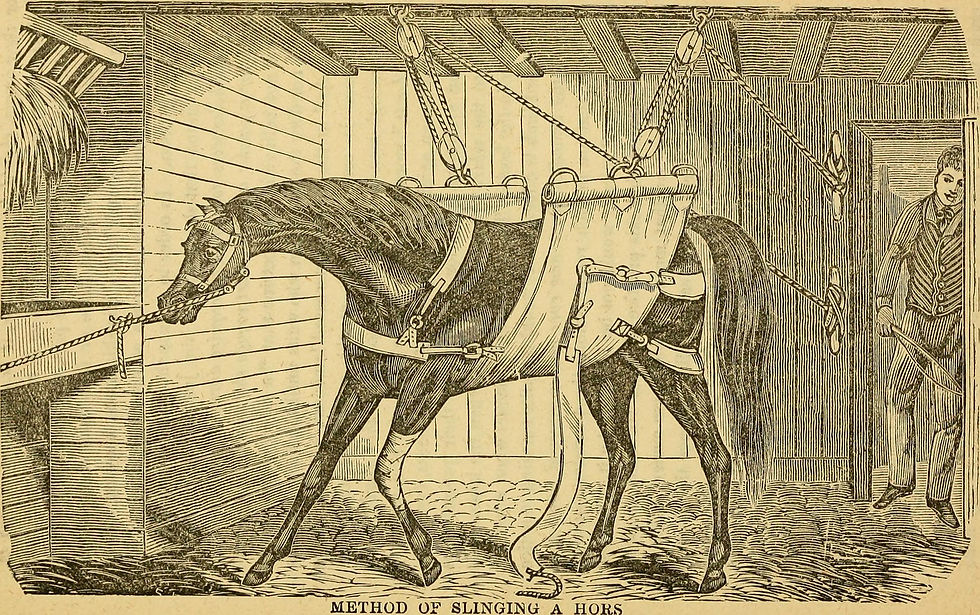
This was quite radical - most owners viewed the horse merely as a working machine at this time. The new approach of understanding the horse's needs and providing for its health and comfort led to the introduction of horse hospitals. The first was in Camden Goods Yard (now Camden Market). It was a two-storey building with a ramp at the side to enable the horses to get to the upper floor and it could accommodate 92 horses. Injured horses could rest inside, suspended in a sling hanging from hooks on the rafters. A similar horse hospital at the Goods Yard in Kings Cross had a pond where horses could bathe.
As well as promoting the humane treatment of horses, manuals countered ignorance about diseases which could be exploited by unscrupulous dealers. Such people would sell a horse to an unwitting customer then offer to buy it back for a pittance once someone had helpfully pointed out a potential problem to them. The someone, of course, being in on the ruse.
By the 1890s, when Hardy wrote The Fiddler of the Reels, the professional discipline of veterinary science had emerged. My ancestors were horse dealers in Ramsgate at that time. When they were involved in a court case to decide liability for a horse which had become lame, no less than four different local vets were called upon to give their opinion. They all had 25 or 30 years' experience and one was an MRCVS (Member of the Royal College of Veterinary Surgeons). This designation confirmed he had met the required educational, ethical, and clinical standards set by the Royal College of Veterinary Surgeons, the regulatory body established in 1844. Interestingly, however, the magistrate had the deciding vote when two vets declared the horse sound and two diagnosed it with side-bone. The vets were cross-examined about how serious a condition this was, how it would manifest and whether it would stop the horse working. When no consensus was reached, a layperson effectively decided who to listen to.
Read more about ...

Comments